
“Under heaven all can see beauty as beauty,
only because there is ugliness.
All can know good as good because there is evil.
Being and nonbeing produce each other.
The dificult is born in the easy.
Long is defined by short, the high by the low.
Before and after go along with each other.
So the sage lives openly with apparent duality and paradoxical unity.
The sage can act without effort and teach without words.
Nurturing things without possessing them, he works, but not for rewards;
he competes, but not for results.
When the work is done, it is forgotten.
That is why it lasts forever.”
This interpretation is from the book “Change Your
Thoughts – Change Your Life, Living the Wisdom of the Tao” by Dr. Wayne W. Dyer
The Pull of Duality
This verse discusses duality: if I call something “good,” naturally there is the notion of “bad.” If I say this is “beautiful,” then “ugly” follows. High and low, right and wrong, each creates its opposite.
At first, this felt tricky to me. Labels aren’t always negative. Sometimes they’re just descriptions. Saying “the pan is hot” is simply naming reality. But when I label people or situations as right or wrong, judgment slips in and can change how I treat others, often without me even realizing it.
Duality doesn’t have to mean conflict. Sometimes two things can be true at the same time.
Labels vs. Let it Be
I notice how easy it is to judge—whether it’s how someone drives, the choices the people I care about make, or even how I look at myself in relation to others. I don’t like being judged, yet I can catch myself doing it.
The Tao reminds me to pause and reframe. Can I see without disapproving? Can I allow without labeling? When I do, I find my heart softens, and relationships feel lighter, calmer.
Just Being and Wu Wei
This verse also points to Wu Wei, effortless action, moving with the current instead of fighting it.
I find it in simple, ordinary moments: sipping coffee on a quiet Saturday morning, watering the garden in the sun, watching bees gather pollen. There’s no forcing, no outcome to chase. No agenda other than the task at hand. Just being.
Writing sometimes feels this way too, when the words pour out and my fingers can hardly keep up. Or cleaning out a closet, moving easily until I reach something that requires a decision. That pause, that resistance, is where effort sneaks back in.
I once heard Wu Wei described through the nursery rhyme:
Row, row, row your boat, gently down the stream. Merrily, merrily, merrily, merrily life is but a dream.
Whenever I kayak, I feel the truth of it. Paddle upstream and everything is a struggle. Turn with the current and the water carries me. Why, I ask myself, do I keep trying to paddle the wrong way—not only in my kayak, but in life? I need the reminder: Be like water.
Letting Go of Control
For me, Wu Wei also means stepping back in relationships. At work, I realized I don’t always need to have the last word or prove my point. Just listening—without needing to win—makes me happier and more at peace.
This verse, in one translation from Tolbert McCarroll, says: “Nourish them without claiming authority, benefit them without demanding gratitude.” It reminds me that I don’t need to jump in with advice, try to fix things, or expect recognition. I can simply let others be.
Not everyone wants to hear what I have to say, and that’s okay. I don’t have to be unkind, but I also don’t have to force myself to be understood. Acceptance feels lighter than control.
Companions: Joy and Sorrow
Joy and sorrow may seem like opposites, but really, they are companions.
I feel sorrow because I experienced joy. Both come from love, and both remind me of my capacity to feel deeply. The love is still there. My experiences and memories are still a part of me. Welcoming both is part of honoring life’s fullness.
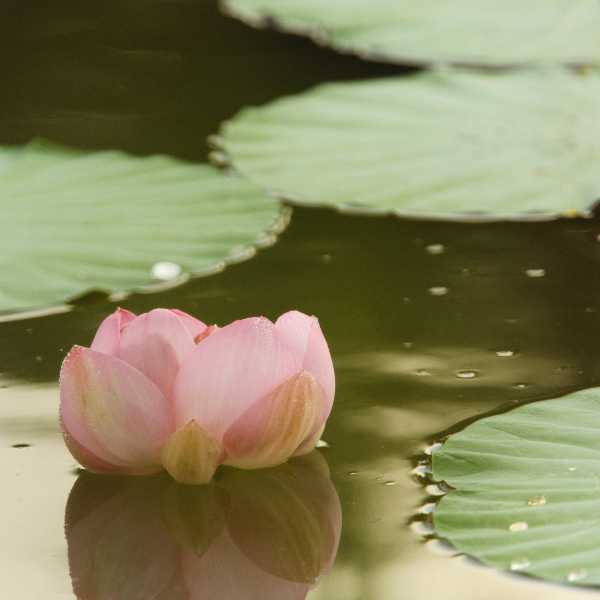
It does remind me of the phrase, “No Mud, No Lotus” said by the Buddhist monk Thich Nhat Hahn and talked about in his book, “No Mud, No Lotus: The Art of Transforming Suffering“. He encourages us to see hardships and pain as something to embace with tenderness and compasion and use it to have a new appreciation for life and others.
When I begin to change the way I look at or think about perceived opposites, I can alter how I live my life.
Flow vs. Forcing
I’ve learned to notice what flow feels like in my body: calm, natural, peaceful. That’s when I’m in harmony with life. Forcing feels like tension, anxiety, resistance, like paddling upstream.
Verse 2 invites me to stop fighting with labels, opposites, and outcomes, and instead trust the flow. To allow things, and myself, to be as they are.
This moment, right now, is enough. And so am I.
I searched for some journaling prompts to help me dive a little deeper into understanding this verse. I’ll share a few here. If you would like to see all the questions I used, use the “Let’s Talk” link below and I’ll send them to you.
- Where do I find myself label experiences as “good” or “bad”?
- What shifts when I let go of the labels?
- What does “just being” look like for me today?
- When have I felt most at peace by not trying to control evereything?
Remember to be kind to yourself.
Living a Tao Centered Life
Ask yourself, where can I soften and allow things to unfold naturally?
Let me know what you think. I’m always open to a thoughtful discussion.